CompTIA Security+ Simulation 8

HOTSPOT
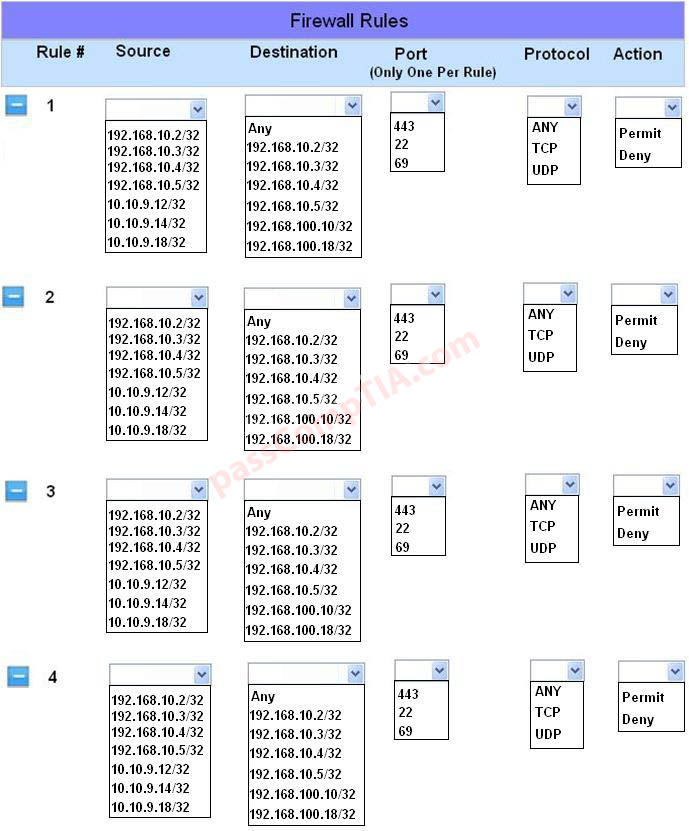
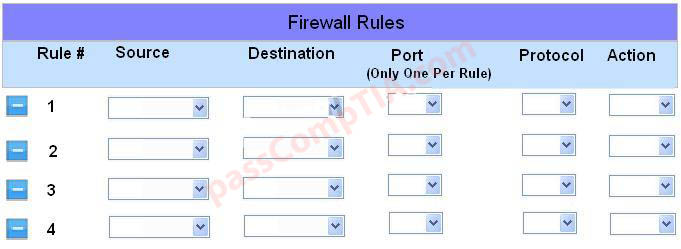
The security administrator has installed a new firewall which implements an implicit DENY policy by default Click on the firewall and configure it to allow ONLY the following communication.

1. The Accounting workstation can ONLY access the web server on the public network over the default HTTPS port. The accounting workstation should not access other networks.
2. The HR workstation should be restricted to communicate with the Financial server ONLY, over the default SCP port
3. The Admin workstation should ONLY be able to access the servers on the secure network over the default TFTP port.

Instructions: The firewall will process the rules in a top-down manner in order as a first match. The port number must be typed in and only one port number can be entered per rule Type ANY for all ports. The original firewall configuration can be reset at any time by pressing the reset button. Once you have met the simulation requirements, click save and then Done to submit.


Correct Answer:


Implicit deny is the default security stance that says if you aren’t specifically granted access or privileges for a resource, you’re denied access by default.

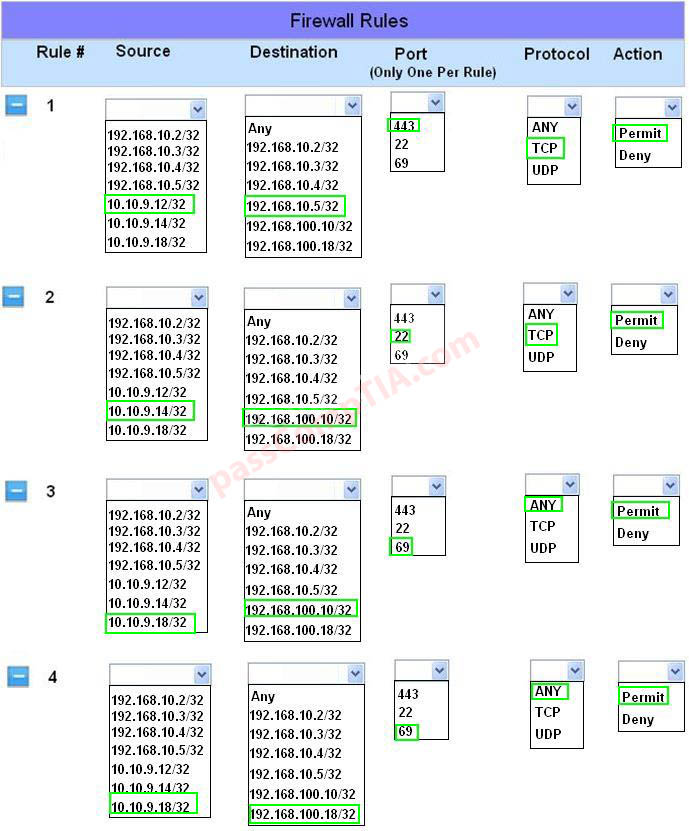
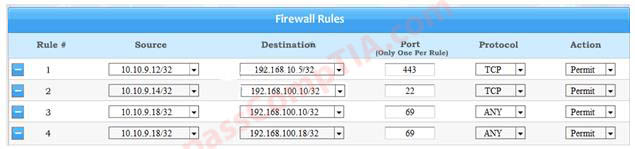
Rule #1 allows the Accounting workstation to ONLY access the web server on the public network over the default HTTPS port, which is TCP port 443.

Rule #2 allows the HR workstation to ONLY communicate with the Financial server over the default SCP port, which is TCP Port 22

Rule #3 & Rule #4 allow the Admin workstation to ONLY access the Financial and Purchasing servers located on the secure network over the default TFTP port, which is Port 69.

References:
Stewart, James Michael, CompTIA Security+ Review Guide, Sybex, Indianapolis
http://en.wikipedia.org/wiki/List_of_TCP_and_UDP_port_numbers

CompTIA Security+ Simulation 7

A Security administrator wants to implement strong security on the company smart phones and terminal servers located in the data center. Drag and Drop the applicable controls to each asset type.

Instructions: Controls can be used multiple times and not all placeholders needs to be filled. When you have completed the simulation, Please select Done to submit.

Correct Answer:


Cable locks are used as a hardware lock mechanism – thus best used on a Data Center Terminal Server.

Network monitors are also known as sniffers – thus best used on a Data Center Terminal Server.

Install antivirus software. Antivirus software should be installed and definitions kept current on all hosts. Antivirus software should run on the server as well as on every workstation. In addition to active monitoring of incoming fi les, scans should be conducted regularly to catch any infections that have slipped through- thus best used on a Data Center Terminal Server.

Proximity readers are used as part of physical barriers which makes it more appropriate to use on a center’s entrance to protect the terminal server.

Mentor app is an Apple application used for personal development and is best used on a mobile device such as a smart phone.

Remote wipe is an application that can be used on devices that are stolen to keep data safe. It is basically a command to a phone that will remotely clear the data on that phone. This process is known as a remote wipe, and it is intended to be used if the phone is stolen or going to another user.

Should a device be stolen, GPS (Global Positioning System) tracking can be used to identify its location and allow authorities to find it – thus best used on a smart phone.

Screen Lock is where the display should be configured to time out after a short period of inactivity and the screen locked with a password. To be able to access the system again, the user must provide the password. After a certain number of attempts, the user should not be allowed to attempt any additional logons; this is called lockout – thus best used on a smart phone.

Strong Password since passwords are always important, but even more so when you consider that the device could be stolen and in the possession of someone who has unlimited access and time to try various values – thus best use strong passwords on a smartphone as it can be stolen more easily than a terminal server in a data center.

Device Encryption- Data should be encrypted on the device so that if it does fall into the wrong hands, it cannot be accessed in a usable form without the correct passwords. It is recommended to you use Trusted Platform Module (TPM) for all mobile devices where possible.

Use pop-up blockers. Not only are pop-ups irritating, but they are also a security threat. Pop-ups (including pop-unders) represent unwanted programs running on the system, and they can jeopardize the system’s well-being. This will be more effective on a mobile device rather than a terminal server.

Use host-based firewalls. A firewall is the first line of defense against attackers and malware. Almost every current operating system includes a firewall, and most are turned on by Default- thus best used on a Data Center Terminal Server.

References:
Dulaney, Emmett and Chuck Eastton, CompTIA Security+ Study Guide, 6th Edition, Sybex,
Indianapolis

CompTIA Network+ Question D-6

A company owns four kiosks that are in close proximity within a shopping center. The owner is concerned about someone accessing the internet via the kiosk’s wireless network. Which of the following should be implemented to provide wireless access only to the employees working at the kiosk?

A. Firewall
B. Web filtering
C. MAC filtering
D. Host-based antivirus

Correct Answer: C

CompTIA Network+ Question C-76

A network technician is tasked with designing a firewall to improve security for an existing FTP server that is on the company network and is accessible from the internet. The security concern is that the FTP server is compromised it may be used as a platform to attack other company servers. Which of the following is the BEST way to mitigate this risk?

A. Add an outbound ACL to the firewall
B. Change the FTP server to a more secure SFTP
C. Use the implicit deny of the firewall
D. Move the server to the DMZ of the firewall

Correct Answer: D

CompTIA Network+ Question C-64

The Chief Information Officer (CIO) of an organization is concerned that the current locally-hosted, software threat solution is not agile enough. The CIO points to specific examples of zero-day threats that have recently taken a day or more to receive patches. The IT team is tasked with finding a solution that has a better chance of stopping emerging threats and stopping zero-day threats more quickly. Which of the following solutions would have the BEST chance of meeting these goals?

A. Stateful firewall
B. Premise-based IDS
C. Host-based IDS
D. Cloud-based anti-malware

Correct Answer: A

CompTIA Network+ Question C-60

Jane, a network technician is preparing to configure a company’s network. She has installed a firewall to allow for an internal DMZ and external network. No hosts on the internal network should be directly accessible by IP address from the internet, but they should be able to communicate with remote networks after receiving a proper IP address. Which of the following is an addressing scheme that will work in this situation?

A. Teredo tunneling
B. Private
C. APIPA
D. Classless

Correct Answer: B

CompTIA Network+ Question C-56

A technician is installing a surveillance system for a home network. The technician is unsure which ports need to be opened to allow remote access to the system. Which of the following should the technician perform?

A. Disable the network based firewall
B. Implicit deny all traffic on network
C. Configure a VLAN on Layer 2 switch
D. Add the system to the DMZ

Correct Answer: D

Explanation:
By putting the system in the DMZ (demilitarized zone) we increase the security, as the system should be opened for remote access.
A DMZ is a computer host or small network inserted as a “neutral zone” between a company’s private network and the outside public network. It prevents outside users from getting direct access to a server that has company data. A DMZ often contains servers that should be accessible from the public Internet.

CompTIA Network+ Question C-51

A technician configures a firewall in the following manner in order to allow HTTP traffic.

Source IPZone: Any Untrust
Dest IPZone: Any DMZ
Port: 80
Action: Allow

The organization should upgrade to which of the following technologies to prevent unauthorized traffic from traversing the firewall?

A. HTTPS
B. Stateless packet inspection
C. Intrusion detection system
D. Application aware firewall

Correct Answer: D

CompTIA Network+ Question C-43

A network administrator is following best practices to implement firewalls, patch management and policies on the network. Which of the following should be performed to verify the security controls in place?

A. Penetration testing
B. AAA authentication testing
C. Disaster recovery testing
D. Single point of failure testing

Correct Answer: A

CompTIA Network+ Question C-40

A network technician needs to set up two public facing web servers and watns to ensure that if they are compromised the intruder cannot access the intranet. Which of the following security techniques should be used?

A. Place them behind honeypots
B. Place them in a separate subnet
C. Place them between two internal firewalls
D. Place them in the demilitarized zone

Correct Answer: D