CompTIA Security+ Question A-89

Which of the following is BEST used to capture and analyze network traffic between hosts on the same network segment?

A. Protocol analyzer
B. Router
C. Firewall
D. HIPS

Answer: A

Explanation:
A Protocol Analyzer is a hardware device or more commonly a software program used to capture network data communications sent between devices on a network. Capturing and analyzing the packets sent from two systems that are not communicating properly could help determine the cause of the issue. Well known software protocol analyzers include Message Analyzer (formerly Network Monitor) from Microsoft and Wireshark (formerly Ethereal).

CompTIA Security+ Question A-81

A security technician is working with the network firewall team to implement access controls at the company’s demarc as part of the initiation of configuration management processes. One of the network technicians asks the security technician to explain the access control type found in a firewall. With which of the following should the security technician respond?

A. Rule based access control
B. Role based access control
C. Discretionary access control
D. Mandatory access control

Answer: A

Explanation:
Rule-based access control is used for network devices, such as firewalls and routers, which filter traffic based on filtering rules.

CompTIA Security+ Question A-80

A network administrator identifies sensitive files being transferred from a workstation in the LAN to an unauthorized outside IP address in a foreign country. An investigation determines that the firewall has not been altered, and antivirus is up-to-date on the workstation. Which of the following is the MOST likely reason for the incident?

A. MAC Spoofing
B. Session Hijacking
C. Impersonation
D. Zero-day

Answer: D

Explanation:
This question states that antivirus is up-to-date on the workstation and the firewall has not been altered. The antivirus software is up to date with all ‘known’ viruses. A zero day vulnerability is an unknown vulnerability so a patch or virus definition has not been released yet.

A zero day vulnerability refers to a hole in software that is unknown to the vendor. This security hole is then exploited by hackers before the vendor becomes aware and hurries to fix it—this exploit is called a zero day attack. Uses of zero day attacks can include infiltrating malware, spyware or allowing unwanted access to user information. The term “zero day” refers to the unknown nature of the hole to those outside of the hackers, specifically, the developers. Once the vulnerability becomes known, a race begins for the developer, who must protect users.

CompTIA Security+ Question A-79

An overseas branch office within a company has many more technical and non-technical security incidents than other parts of the company. Which of the following management controls should be introduced to the branch office to improve their state of security?

A. Initial baseline configuration snapshots
B. Firewall, IPS and network segmentation
C. Event log analysis and incident response
D. Continuous security monitoring processes

Answer: D

Explanation:
Continuous monitoring may involve regular measurements of network traffic levels, routine evaluations for regulatory compliance, and checks of network security device configurations. It also points toward the never-ending review of what resources a user actually accesses, which is critical for preventing insider threats.

Incorrect Options:

A: An initial baseline configuration snapshot would allow for the standardized minimal level of security that all systems in an organization must comply with to be enforced. This will not cover the non-technical security incidents.

B: A Firewall, IPS and network segmentation will offer technical protection, but not non-technical security protection.

C: Event log analysis and incident response will not cover the non-technical security incidents.

Reference:

Dulaney, Emmett and Chuck Eastton, CompTIA Security+ Study Guide, 6th Edition, Sybex, Indianapolis, 2014, p. 154.

Stewart, James Michael, CompTIA Security+ Review Guide, Sybex, Indianapolis, 2014, pp. 207, 208

CompTIA Security+ Question A-76

An organization is required to log all user internet activity. Which of the following would accomplish this requirement?

A. Configure an access list on the default gateway router. Configure the default gateway router to log all web traffic to a syslog server
B. Configure a firewall on the internal network. On the client IP address configuration, use the IP address of the firewall as the default gateway, configure the firewall to log all traffic to a syslog server
C. Configure a proxy server on the internal network and configure the proxy server to log all web traffic to a syslog server
D. Configure an access list on the core switch, configure the core switch to log all web traffic to a syslog server

Answer: C

CompTIA Security+ Question A-72

It is MOST important to make sure that the firewall is configured to do which of the following?

A. Alert management of a possible intrusion.
B. Deny all traffic and only permit by exception.
C. Deny all traffic based on known signatures.
D. Alert the administrator of a possible intrusion.

Answer: B

Explanation:
Firewalls manage traffic using filters, which is just a rule or set of rules. A recommended guideline for firewall rules is, “deny by default; allow by exception”.

CompTIA Security+ Question A-60

A new virtual server was created for the marketing department. The server was installed on an existing host machine. Users in the marketing department report that they are unable to connect to the server. Technicians verify that the server has an IP address in the same VLAN as the marketing department users. Which of the following is the MOST likely reason the users are unable to connect to the server?

A. The new virtual server’s MAC address was not added to the ACL on the switch
B. The new virtual server’s MAC address triggered a port security violation on the switch
C. The new virtual server’s MAC address triggered an implicit deny in the switch
D. The new virtual server’s MAC address was not added to the firewall rules on the switch

Answer: A

Explanation:
Configuring the switch to allow only traffic from computers based upon their physical address is known as MAC filtering. The physical address is known as the MAC address. Every network adapter has a unique MAC address hardcoded into the adapter. You can configure the ports of a switch to allow connections from computers with specific MAC addresses only and block all other MAC addresses. In computer networking, MAC Filtering (or GUI filtering, or layer 2 address filtering) refers to a security access control method whereby the 48-bit address assigned to each network card is used to determine access to the network. MAC addresses are uniquely assigned to each card, so using MAC filtering on a network permits and denies network access to specific devices through the use of blacklists and whitelists. While the restriction of network access through the use of lists is straightforward, an individual person is not identified by a MAC address, rather a device only, so an authorized person will need to have a whitelist entry for each device that he or she would use to access the network.

CompTIA Security+ Question A-52

Customers’ credit card information was stolen from a popular video streaming company. A security consultant determined that the information was stolen, while in transit, from the gaming consoles of a particular vendor. Which of the following methods should the company consider to secure this data in the future?

A. Application firewalls
B. Manual updates
C. Firmware version control
D. Encrypted TCP wrappers

Answer: D

Explanation:
Wrapping sensitive systems with a specific control is required when protecting data in transit. TCP wrappers are also security controls. TCP Wrapper is a host-based networking ACL system, used to filter network access to Internet Protocol servers on (Unix-like) operating systems such as Linux

or BSD. It allows host or subnetwork IP addresses, names and/or inetd query replies, to be used as tokens on which to filter for access control purposes. TCP Wrapper should not be considered a replacement for a properly configured firewall. Instead, TCP Wrapper should be used in conjunction with a firewall and other security enhancements in order to provide another layer of protection in the implementation of a security policy.

CompTIA Security+ Question A-1

Which of the following should the security administrator implement to limit web traffic based on country of origin? (Select THREE).

A. Spam filter
B. Load balancer
C. Antivirus
D. Proxies
E. Firewall
F. NIDS
G. URL filtering

Answer: D,E,G

Explanation:
A proxy server is a server that acts as an intermediary for requests from clients seeking resources from other servers. Firewalls manage traffic using a rule or a set of rules. A URL is a reference to a resource that specifies the location of the resource. A URL filter is used to block access to a site based on all or part of a URL.

CompTIA Security+ Simulation 15

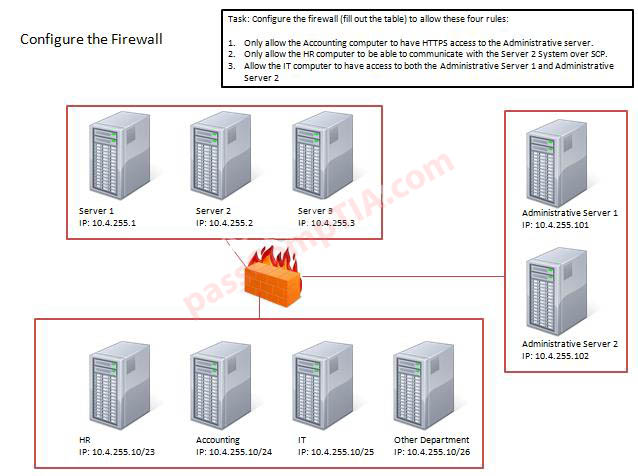
Configure the firewall to allow these four rules:
Correct Answer:

Use the following answer for this simulation task.

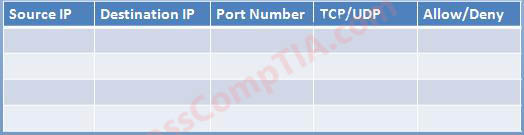
Source IP Destination IP Port number TCP/UDP Allow/Deny
10.4.255.10/24 10.4.255.101 443 TCP Allow
10.4.255.10/23 10.4.255.2 22 TCP Allow
10.4.255.10/25 10.4.255.101 Any Any Allow
10.4.255.10/25 10.4.255.102 Any Any Allow

Firewall rules act like ACLs, and they are used to dictate what traffic can pass between the firewall and the internal network. Three possible actions can be taken based on the rule’s criteria:
– Block the connection
– Allow the connection
– Allow the connection only if it is secured

TCP is responsible for providing a reliable, one-to-one, connection-oriented session. TCP establishes a connection and ensures that the other end receives any packets sent. Two hosts communicate packet results with each other. TCP also ensures that packets are decoded and sequenced properly. This connection is persistent during the session. When the session ends, the connection is torn down.

UDP provides an unreliable connectionless communication method between hosts. UDP is considered a best-effort protocol, but it’s considerably faster than TCP. The sessions don’t establish a synchronized session like the kind used in TCP, and UDP doesn’t guarantee error-free communications. The primary purpose of UDP is to send small packets of information. The application is responsible for acknowledging the correct reception of the data.

Port 22 is used by both SSH and SCP with UDP.
Port 443 is used for secure web connections – HTTPS and is a TCP port.

Thus to make sure only the Accounting computer has HTTPS access to the Administrative server you should use TCP port 443 and set the rule to allow communication between 10.4.255.10/24 (Accounting) and 10.4.255.101 (Administrative server1)

Thus to make sure that only the HR computer has access to Server2 over SCP you need use of TCP port 22 and set the rule to allow communication between 10.4.255.10/23 (HR) and 10.4.255.2 (server2)

Thus to make sure that the IT computer can access both the Administrative servers you need to use a port and accompanying port number and set the rule to allow communication between:
10.4.255.10.25 (IT computer) and 10.4.255.101 (Administrative server1)
10.4.255.10.25 (IT computer) and 10.4.255.102 (Administrative server2)

References:
Dulaney, Emmett and Chuck Eastton, CompTIA Security+ Study Guide, Sybex, Indianapolis