A security controls assessor intends to perform a holistic configuration compliance test of networked assets. The assessor has been handed a package of definitions provided in XML format, and many of the files have two common tags within them: “<object object_ref=… />” and “<state state_ref=… />”.
Which of the following tools BEST supports the use of these definitions?
A. HTTP interceptor
B. Static code analyzer
C. SCAP scanner
D. XML fuzzer
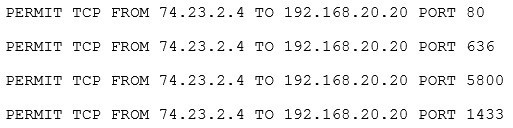
A company wants to extend its help desk availability beyond business hours. The Chief Information Officer (CIO) decides to augment the help desk with a third- party service that will answer calls and provide Tier 1 problem resolution, such as password resets and remote assistance. The security administrator implements the following firewall change:
The administrator provides the appropriate path and credentials to the third-party company. Which of the following technologies is MOST likely being used to provide access to the third company?
An architect was recently hired by a power utility to increase the security posture of the company’s power generation and distribution sites. Upon review, the architect identifies legacy hardware with highly vulnerable and unsupported software driving critical operations. These systems must exchange data with each other, be highly synchronized, and pull from the Internet time sources. Which of the following architectural decisions would BEST reduce the likelihood of a successful attack without harming operational capability? (Choose two.)
A. Isolate the systems on their own network
B. Install a firewall and IDS between systems and the LAN
C. Employ own stratum-0 and stratum-1 NTP servers
D. Upgrade the software on critical systems
E. Configure the systems to use government-hosted NTP servers
A company contracts a security engineer to perform a penetration test of its client-facing web portal. Which of the following activities would be MOST appropriate?
A. Use a protocol analyzer against the site to see if data input can be replayed from the browser
B. Scan the website through an interception proxy and identify areas for the code injection
C. Scan the site with a port scanner to identify vulnerable services running on the web server
D. Use network enumeration tools to identify if the server is running behind a load balancer
A large enterprise with thousands of users is experiencing a relatively high frequency of malicious activity from the insider threats. Much of the activity appears to involve internal reconnaissance that results in targeted attacks against privileged users and network file shares. Given this scenario, which of the following would MOST likely prevent or deter these attacks? (Choose two.)
A. Conduct role-based training for privileged users that highlights common threats against them and covers best practices to thwart attacks
B. Increase the frequency at which host operating systems are scanned for vulnerabilities, and decrease the amount of time permitted between vulnerability identification and the application of corresponding patches
C. Enforce command shell restrictions via group policies for all workstations by default to limit which native operating system tools are available for use
D. Modify the existing rules of behavior to include an explicit statement prohibiting users from enumerating user and file directories using available tools and/or accessing visible resources that do not directly pertain to their job functions
E. For all workstations, implement full-disk encryption and configure UEFI instances to require complex passwords for authentication
F. Implement application blacklisting enforced by the operating systems of all machines in the enterprise
To meet a SLA, which of the following document should be drafted, defining the company’s internal interdependent unit responsibilities and delivery timelines.
A. BPA
B. OLA
C. MSA
D. MOU
Correct Answer: B
Explanation:
OLA is an agreement between the internal support groups of an institution that supports SLA. According to the Operational Level Agreement, each internal support group has certain responsibilities to the other group. The OLA clearly depicts the performance and relationship of the internal service groups. The main objective of OLA is to ensure that all the support groups provide the intended ServiceLevelAgreement.
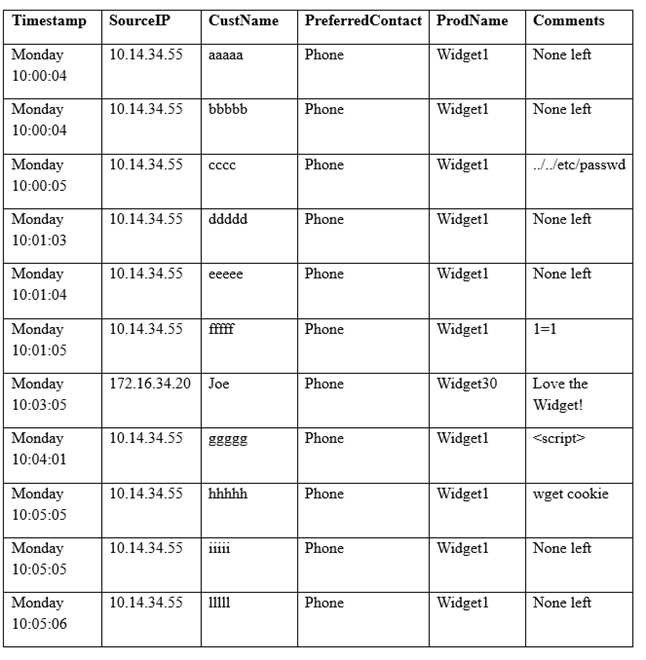
A security analyst sees some suspicious entries in a log file from a web server website, which has a form that allows customers to leave feedback on the company’s products. The analyst believes a malicious actor is scanning the web form. To know which security controls to put in place, the analyst first needs to determine the type of activity occurring to design a control. Given the log below:
Which of the following is the MOST likely type of activity occurring?
A. SQL injection
B. XSS scanning
C. Fuzzing
D. Brute forcing
A company’s existing forward proxies support software-based TLS decryption, but are currently at 60% load just dealing with AV scanning and content analysis for HTTP traffic. More than 70% outbound web traffic is currently encrypted. The switching and routing network infrastructure precludes adding capacity, preventing the installation of a dedicated TLS decryption system. The network firewall infrastructure is currently at 30% load and has software decryption modules that can be activated by purchasing additional license keys. An existing project is rolling out agent updates to end-user desktops as part of an endpoint security refresh.
Which of the following is the BEST way to address these issues and mitigate risks to the organization?
A. Purchase the SSL, decryption license for the firewalls and route traffic back to the proxies for end-user categorization and malware analysis.
B. Roll out application whitelisting to end-user desktops and decommission the existing proxies, freeing up network ports.
C. Use an EDP solution to address the malware issue and accept the diminishing role of the proxy for URL categorization in the short team.
D. Accept the current risk and seek possible funding approval in the next budget cycle to replace the existing proxies with ones with more capacity.
A recent CRM upgrade at a branch office was completed after the desired deadline. Several technical issues were found during the upgrade and need to be discussed in depth before the next branch office is upgraded.
Which of the following should be used to identify weak processes and other vulnerabilities?
A. Gap analysis
B. Benchmarks and baseline results
C. Risk assessment
D. Lessons learned report
A threat advisory alert was just emailed to the IT security staff. The alert references specific types of host operating systems that can allow an unauthorized person to access files on a system remotely. A fix was recently published, but it requires a recent endpoint protection engine to be installed prior to running the fix.
Which of the following MOST likely need to be configured to ensure the system are mitigated accordingly? (Select two.)
A. Antivirus
B. HIPS
C. Application whitelisting
D. Patch management
E. Group policy implementation
F. Firmware updates